
An introduction to the ancient Egyptian pantheon
Ancient Egyptian religion was complex and polytheistic, with multiple deities representing and controlling aspects of the natural environment and concepts such as love and creativity. The worship and rituals associated with these deities formed a core part of ancient Egyptian life and maintaining Ma’at, or divine order, peace and balance.
Blog by Emma Ash, EE Vaile Associate Curator, Archaeology
Ancient Egyptians believed the world was created from chaos - a dark, formless watery abyss often personified as Nu. The story of creation varies through time and across regions and usually centers around a particular deity. In one version of the creation myth, the god Atum rose from the primordial waters (Nu) and created the first piece of land - Ben-ben or sacred mound. Atum then created Shu (god of air) and Tefnut (goddess of moisture). Shu and Tefnut gave birth to Geb (earth) and Nut (sky). Shu and Tefnut then separated the earth and sky, an important event that allowed the creation of the Egyptian pantheon, the universe and everything in it.
Using objects from our collection, this blog highlights some of the well-known gods and goddesses in the ancient Egyptian pantheon exploring the symbols and stories that help identify each deity.
The worship of the Egyptian gods and goddesses began in the Predynastic Period before the time of the Pharoah and continued for thousands of years until the rise of Christianity. After the founding of the Egyptian state, the Pharoah was considered a representation of the gods on earth and responsible for religious tasks and building temples for worship.
The gods and goddesses of ancient Egypt were named and possessed unique abilities, personalities, depictions, and sacred objects. The complex world of the gods had numerous regional variations which changed throughout time as different gods and goddesses rose to prominence. Artistic depictions and ritual and funerary texts showcase the inter-relationships between deities and the blending of deities as their roles shifted across time and region.
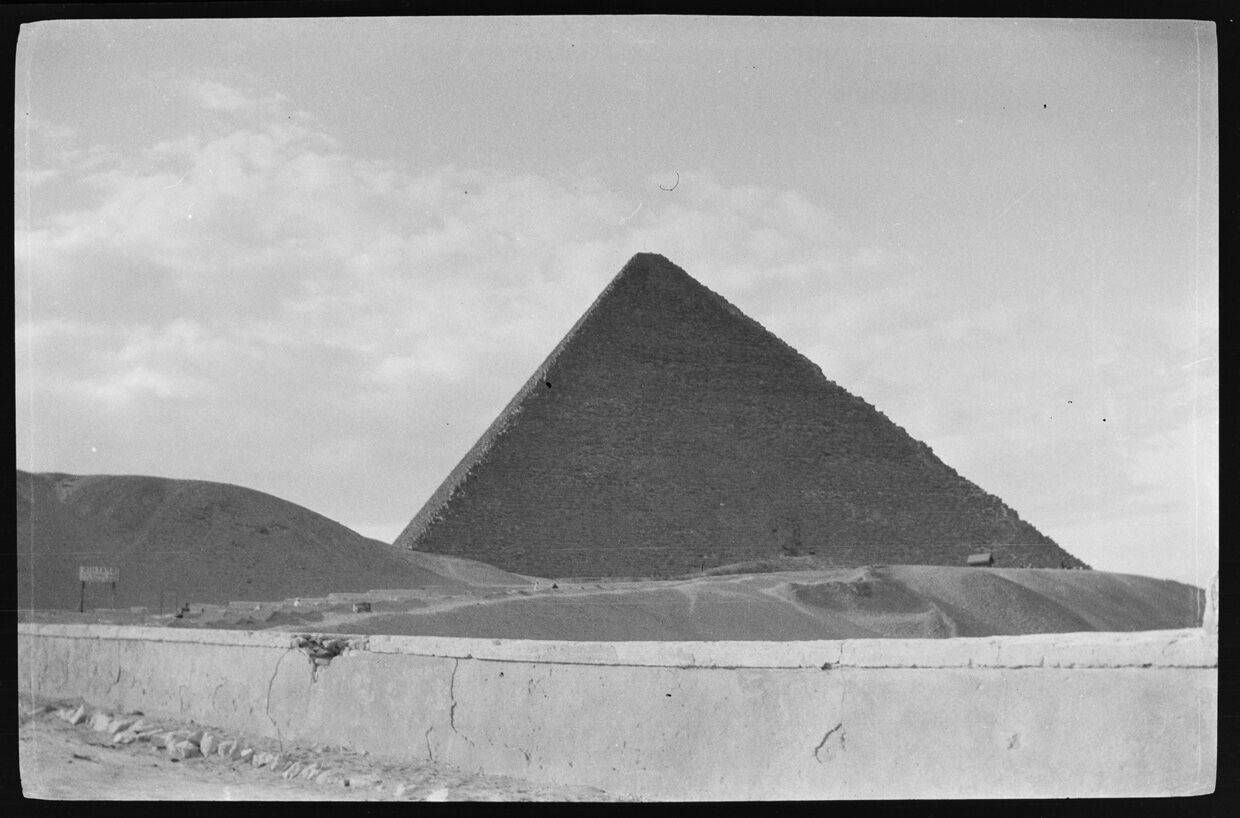
Pyramid circa 1916. Stanley Austin Carr. PH-2015-3-1-32

Amun/Amon
Amun is often associated with the air and one of the primordial deities responsible for the creation of the universe. It was believed that Amun first created himself and then the rest of the world.
Amun’s notoriety evolved throughout history, becoming the king of the gods during the Middle Kingdom and nationally worshipped during the New Kingdom. Amun was merged with the sun god Ra to become Amun-Ra, one of the most powerful deities in Egypt and seen as the father and protector of the Pharoah with Amun often featuring in their royal names. Pharoah Akhenaten overthrew the priests of Amun and briefly replaced the worship of Amun with Aten. This change was reversed during the reign of Akhenaten’s son, Tutankhamun.
Amun is usually represented as a man wearing a crown with two vertical plumes. Amun is also depicted as a goose or snake.
Today the massive temple complex devoted to Amon- Ra at Karnak is one of the most visited monuments in Egypt.
51429 Statuette of Amun wearing double-plumed crown
Osiris
One of the earliest and most important gods, Osiris was ruler of the underworld and symbolised death, resurrection, and the cycle of Nile floods which provided fertile agricultural soils.
According to mythology, Osiris ruled over Egypt until he was murdered by his jealous brother Set who coveted the throne. Set cut Osiris’ body into pieces and scattered his remains throughout Egypt. Osiris’ wife and sister, the goddess Isis, devastated by the loss of her husband, travelled throughout Egypt reassembling Osiris’ body, holding it together with linen wrappings so he could be resurrected long enough to magically conceive a child, the god Horus. Osiris then travelled to the underworld where he now rules.
Osiris is depicted as a mummy holding the crook and flail of kingship. On his head he wears the white crown of Upper Egypt, flanked by two plumes of feathers or with horns of a ram and a beard. His skin is depicted as blue (color of the dead), black (color of the fertile earth) or green (resurrection).
23052.6 Statuette of Osiris on a stone base
Isis/Aset
Goddess of healing and magic, Isis embodied the virtues of wife and mother. As wife to Osiris, Isis is one of the central gods associated with funerary rites and acts as a divine mourner for the dead. She was also believed to aid those passing through to the afterlife as she had done for Osiris.
Isis had many different magical powers and held many roles throughout ancient Egyptian religion and her worship continued into the Greco-Roman period where she was identified with the Greek goddess Aphrodite. The cult of Isis spread throughout the world reaching Britain, Europe, and Asia.
Early depictions of Isis were as a woman with a throne-like hieroglyph as a crown. During the New Kingdom, she adopted a cow horn and sun-disc headdress previously associated with the goddess Hathor. Isis is often shown cradling the infant Horus.
13158 Bronze figure depicting Isis suckling Horus, or a young Pharaoh
Horus
Horus was one of the most significant deities to ancient Egyptians and associated with the sky, war, and hunting. According to the Osiris myth, Horus is the son of Isis and Osiris and was raised in secret to avenge his father’s murder and claim his right to the throne of Egypt. In one version of the story Horus lost his left eye fighting with Set, which was magically healed by the god Thoth. Because Horus’s right and left eye were associated with the sun and moon, the loss and restoration of Horus’s left eye provided an explanation for the phases of the moon.
The eye of Horus or Wedjat is an ancient Egyptian symbol of protection.
Depicted as a falcon or as a man with a falcon head, Horus also embodied divine kingship. Pharoah’s were frequently associated with Horus, as the Pharoah was seen as the earthly representation of the god.
10404 Offering stela depicting Horus holding a was sceptre
Set/Seth
Set was ruler over the desert and god of storms, violence, eclipses and earthquakes. Set was responsible for the murder of his brother Osiris in his attempt to seize the throne of Egypt. Set was defeated at the hands of Osiris’ son Horus after a series of battles which is thought to symbolise the eternal struggle between good and evil. After his defeat, Set joined the sun god Ra, where he became the thunder in the sky and offered protection to Ra from the serpent of chaos during their nightly journey through the underworld.
While Set was often vilified as a powerful and frightening deity, he was venerated by others, becoming the patron of the pharaohs, especially Ramses the Great.
Set is depicted in a variety of animal forms, he is also represented as a man with an unknown, possibly mythical animal head with dog like features and tail.
28687 Bottom of a was sceptre, the other side would have had the head of a Seth animal at the other end
Ptah was central to ancient Egyptian religion, credited with the creation of the world from thoughts in his heart and speech. Ptah was worshipped as the patron of crafts people and architects. The famous architect Imhotep, responsible for the building of the first pyramid was deified as a son of Ptah after his death.
Ptah is depicted in many forms, including dwarf-like and more commonly as a green skinned mummified man with his hands protruding from the linen wrappings, wearing the divine beard and holding a staff representing the three creative powers of Egypt: Power (Was sceptre), life (Ankh) and stability (Djed pillar).
Hathor is one of the oldest goddesses in the Egyptian pantheon, with her worship continuing into the Greco-Roman period, where, like Isis she is compared to the goddess Aphrodite. Hathor was the goddess of love, beauty, pleasure, and fertility and believed to protect women during childbirth. As wife to the god Horus, she was the symbolic wife and mother of Pharoah.
Hathor is often depicted as a cow or women with the head or ears of a cow or as a woman with a headdress of cow horns and sun disc. She is also represented as a lioness, cobra or sycamore tree.
Hapi was the god of the inundation of the Nile. The annual flooding deposited nutrient rich silt supporting agriculture. Hapi symbolised fertility and was typically represented with a prominent belly, breasts and wearing a loin cloth, false beard and headdress made from aquatic plants.
He was thought to reside in the caves at the first Nile cataract named Elephantine where the nilometer, a measuring device that monitored the level of the Nile was located.
Anubis
Anubis was associated with funerary practices such as embalming, cemeteries and care of the dead. Frequently represented in ancient Egyptian art, Anubis is depicted as a jackal, or as a man with the black head of the jackal. The black colour represented the fertile soil of the Nile and symbolises good fortune and rebirth. The association of the jackal with death and funerals, likely arose because they were observed scavenging around cemeteries.
Anubis would also weigh the hearts of the deceased seeking entrance to the afterlife. The heart was placed on a scale against Ma’at’s feather, If the heart weighed more than a feather, the person’s soul was destroyed. If the heart weighed the same as the feather, the deceased would be permitted passage through the underworld into the afterlife.
53416 Bronze statuette of Anubis seated. Point at bottom for stand attachment
Thoth
Thoth was the god of the moon, writing, sciences, mathematics, and wisdom and associated with the concept of divine order and justice. Thoth is credited with the invention of writing (hieroglyphs) and the calendar. Thoth played many roles in Egyptian mythology including wise counselor, settling godly disputes and the judgement of the dead. In scenes of the underworld, showing the judgement of the dead, Thoth is depicted recording the verdict of the heart-weighing ceremony against the feather of Ma’at which determined entry to the afterlife.
Thoth is depicted in the form of a baboon, sacred ibis, or as a man with the head of an ibis with the curve of the beak representing the crescent moon. He is often depicting holding an ankh, the Egyptian symbol for life.
47788 Wood and bronze ibis figure
Bastet
The goddess Bastet is represented as a regal looking cat, sometimes wearing rings in her ears and nose or as a woman with the head of a cat. Originally worshipped as a lioness goddess, a characteristic shared with the goddess Sekhmet. Overtime Bastet and Sekhmet became characterised as two version of the same goddess, with Sekhmet representing the ferocious warrior and Bastet her more peaceful side.
Cats were important to the ancient Egyptians as they protected crops and reduced the spread of disease by killing rodents. Therefore, Bastet was considered the goddess of protection, pregnancy, and good health. During the Ptolemaic period she became associated with the Greek goddess Artemis, the divine hunter and goddess of the moon.
18802 String of beads and amulets. Large amulet represents goddess Bastet
Bes
Bes, the god of music, entertainment, childbirth, and protector of households was widely worshipped throughout Egypt. His music, dancing and lion mask were believed to drive out evil forces and wild animals.
Bes is depicted with a beard, protruding tongue, short torso, long limbs and a crown of feathers. Ancient Egyptians would often decorate their home with images of Bes and his figure is found on a range of household items.
13076 Circular faience plaque with the head of Bes
Sobek
Sobek was a ferocious deity associated with the Nile crocodile and is depicted as a crocodile on an altar or as a man with a crocodile head wearing a headdress with upright feathers and sun-disc. Sobek was also associated with power, fertility, and military prowess but also offered protection from the dangers of the Nile. It was common for crocodiles to be mummified as an offering to Sobek and have been found in numerous Egyptian tombs.
2017.x.577 Amulet of Sobek in profile holding a sceptre or an ankh
Banner photo by AXP Photography on Unsplash